InfraHouse gives startups selling to enterprise a production-ready AWS foundation. Bring a Dockerfile; about 30 minutes later we hand back a running app on ECS with GitHub-managed CI/CD, infrastructure you own from day one, and a clean graduation path into your own AWS Organization — no rebuild.
This page is what that actually looks like.
What lands in your hands.
- A dedicated AWS account inside the InfraHouse AWS Organization (Nursery).
- A containerized service running on ECS Fargate, behind an ALB with ACM TLS.
- A *.infrahouse.app URL pointing at your service.
- ECR for your container images.
- CloudTrail enabled across the account with the right retention.
- Baseline CloudWatch alarms.
- A GitHub Actions CI/CD pipeline deploying on push.
- A runbook describing how to operate, deploy, and roll back.
- About 69 production-grade Terraform modules under github.com/infrahouse, used to build all of the above.
All of it is Terraform-managed in repositories you own from minute one.
A real PR, end to end.
Here is a real production PR — #21 in our own aws-service-infrahouse-app repo. It is small, ordinary, and merged. The workflow is the same on customer repos.
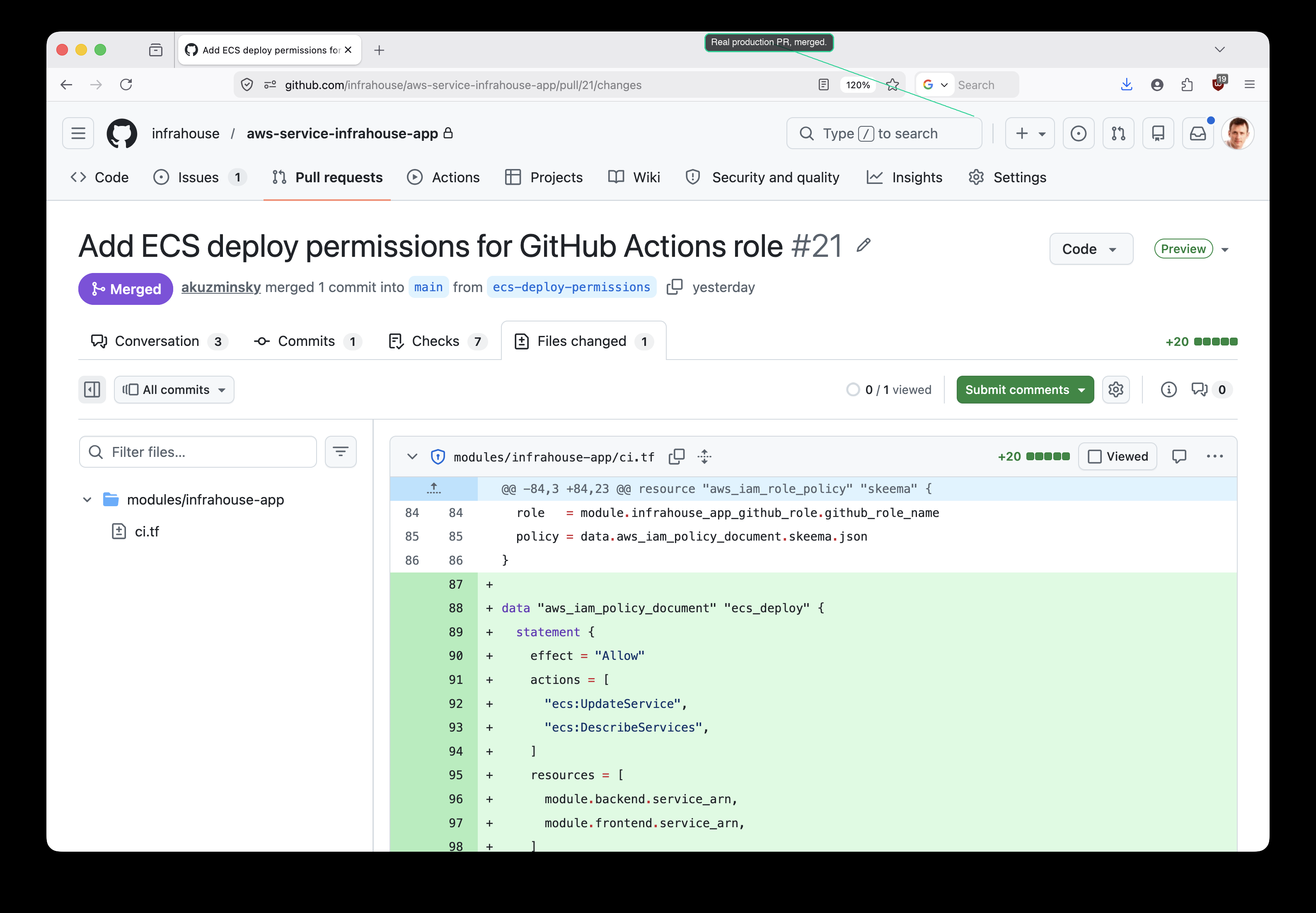
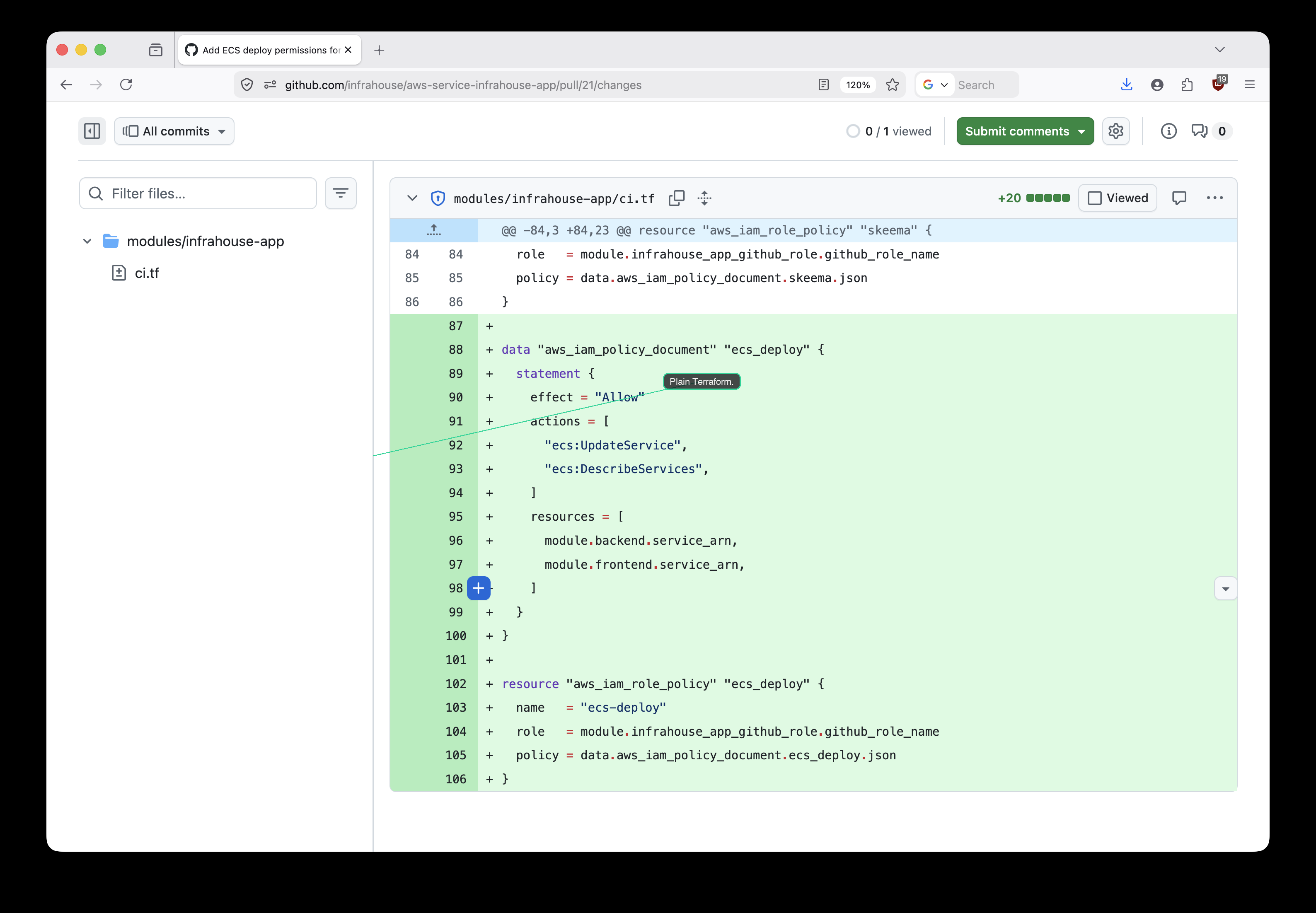
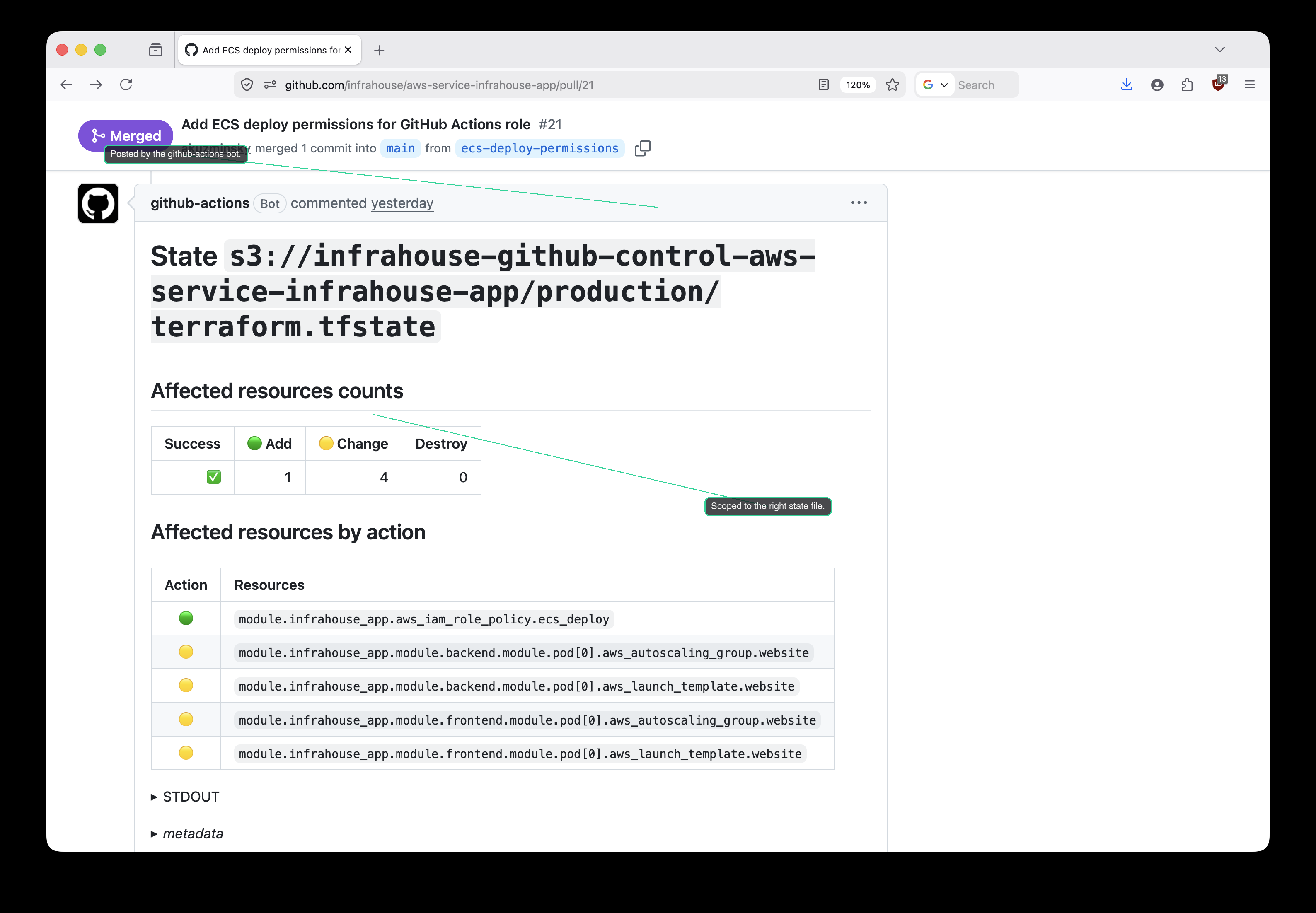
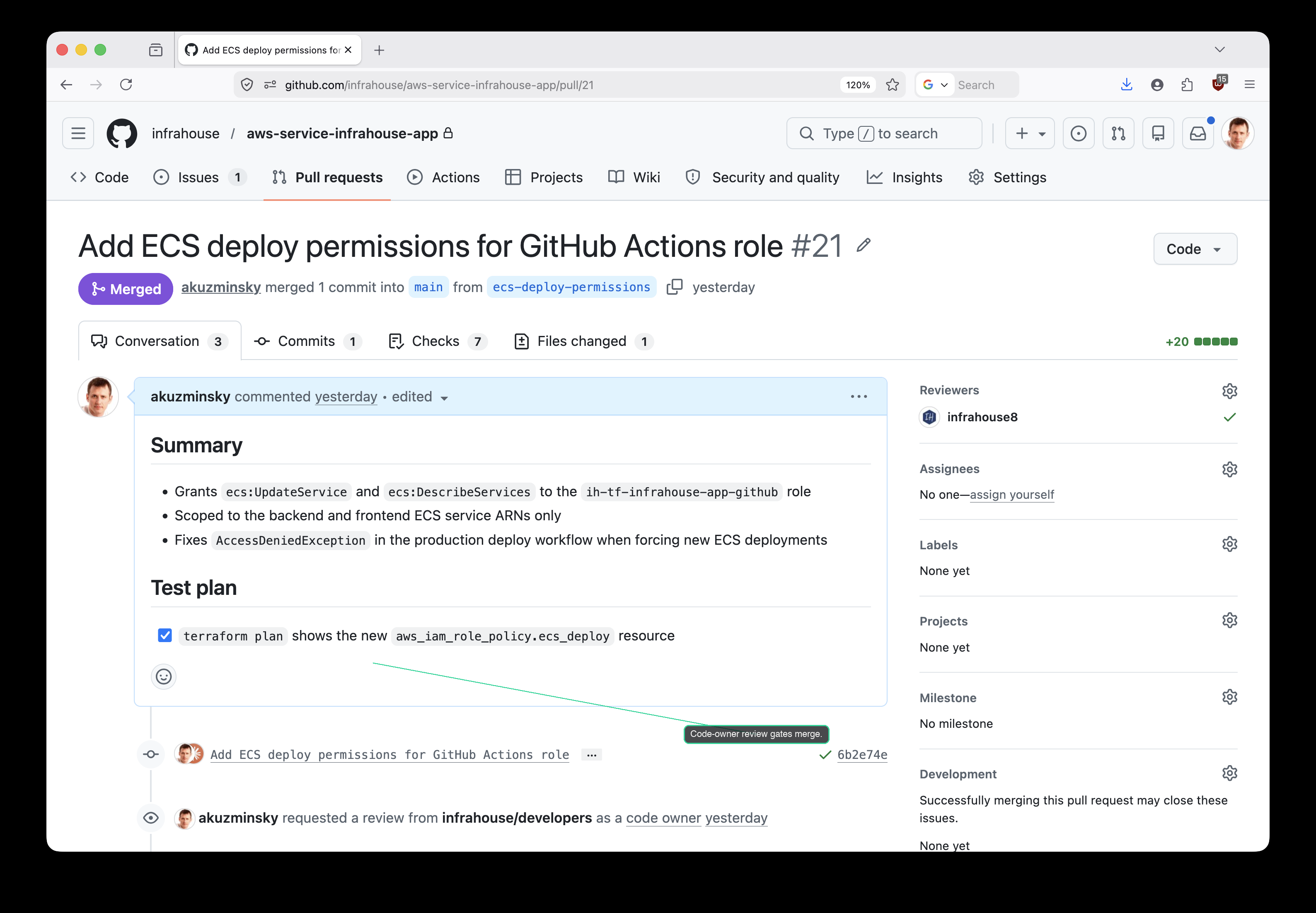
Every Terraform change to your stack flows through a PR like this one.
Opinionated structure, predictable across customers.
Two repos do most of the work. github-control orchestrates the others; service repos like aws-service-infrahouse-app follow a predictable shape so any one of them looks like all of them.
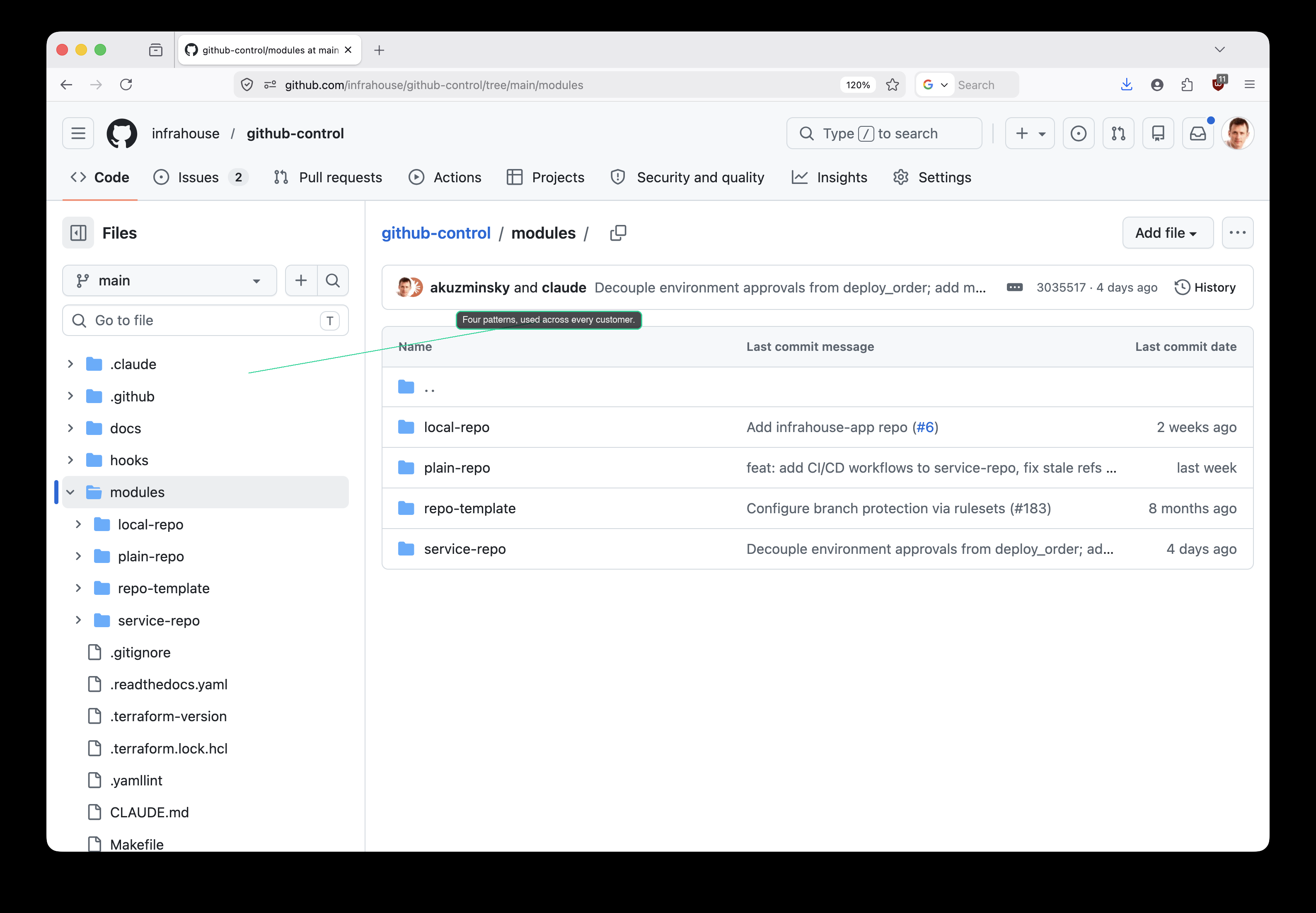
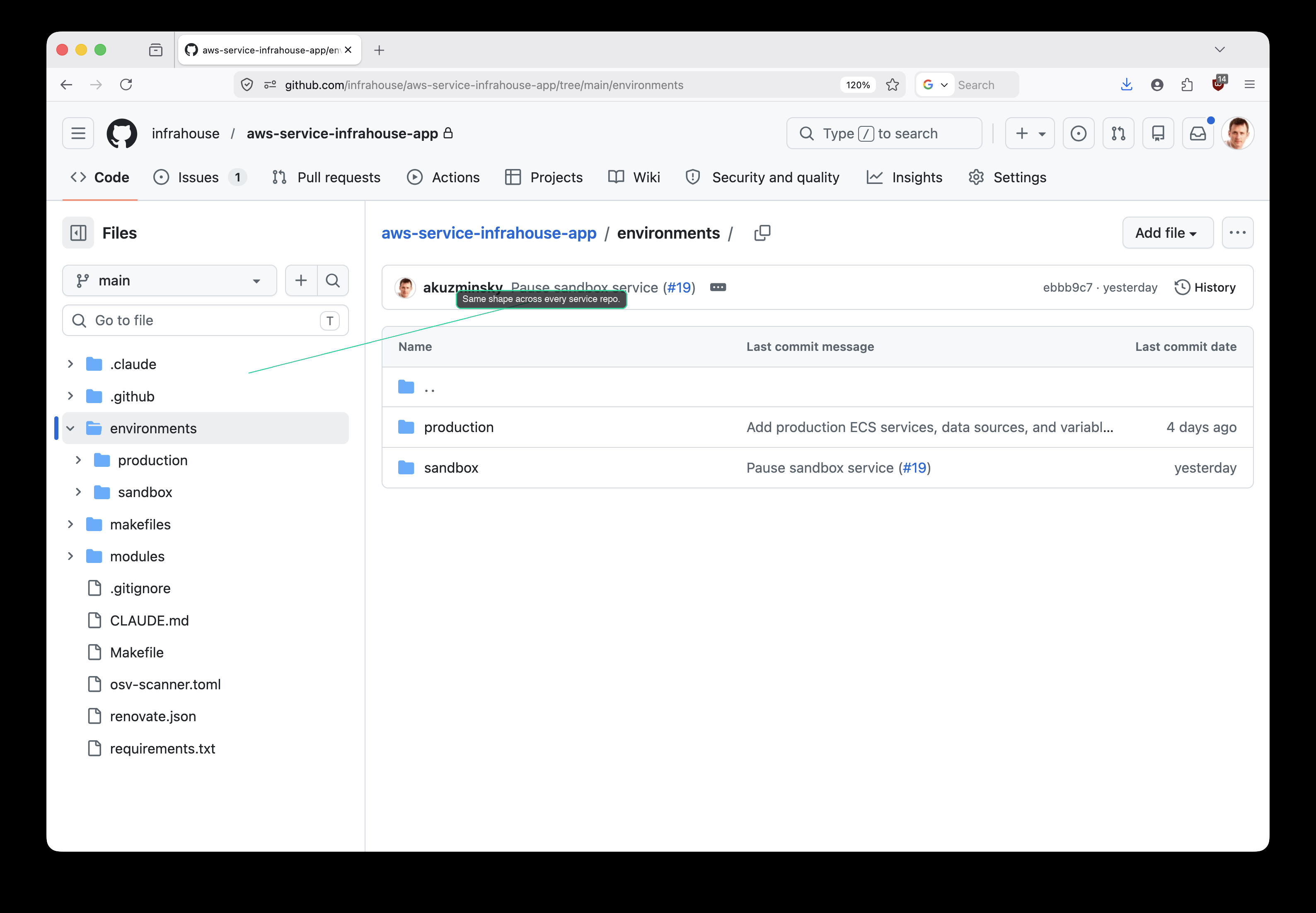
Opinionated structure is the product. It is also what makes the workflow above repeatable.
Nothing lives inside an InfraHouse-only system.
- Your GitHub organization, with every repo, every Terraform module, every workflow file.
- Your AWS account — operated inside our Organization during Nursery, transferred to yours at graduation, with no rebuild.
- The Terraform state, the IAM roles, the secrets, and the runbook.
- The right to read, fork, copy, or walk away with any of it at any time.
If you hire a DevOps engineer next year, they inherit a stack that looks like every other competent AWS setup. No retraining on a proprietary system, because there is no proprietary system.
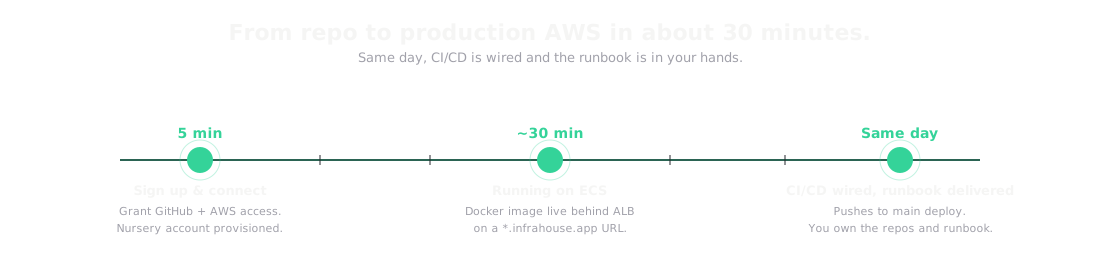
About 30 minutes to first deploy. Same day, you have everything.
More than a single service? That is consulting.
v1 is intentionally narrow — one containerized service, one environment, deployed with the patterns above. It ships fast and audit-clean because the boundary is tight. Anything wider is a scoped consulting engagement.
If you need multiple environments per service, custom domains, managed databases beyond MySQL, background workers, or multi-service deployments under one account, those are the senior-engineer consulting engagements — different shape, different price, same engineer.
$0 rebuild when you move.
When you are ready, the AWS account you have been running on transfers from our AWS Organization into yours. Same account. Same Terraform. Same GitHub workflows. The only thing that changes is the parent Organization and the billing relationship.
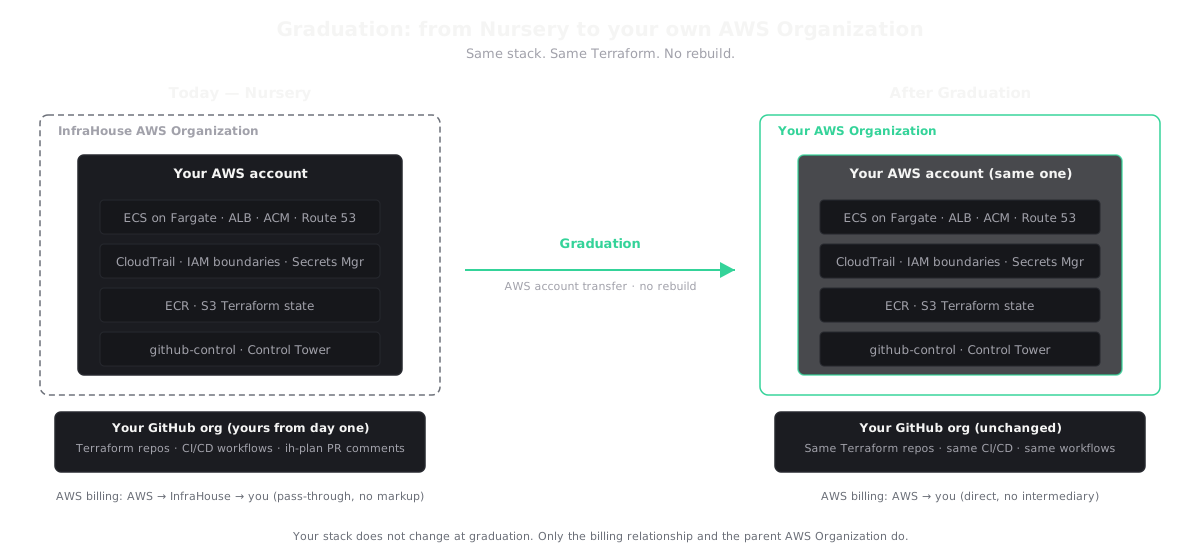
No contract traps you in Nursery. Graduation is a button push, not a project.
Engineers who've shipped with us.
"They surfaced issues we hadn't fully seen and validated instincts our engineers already had. We left with better observability and a concrete roadmap to make our database layer more resilient."
"InfraHouse let us move blazingly fast by automating provisioning with Terraform. Their leadership integrating security best practices was pivotal to our ISO 27001 certification."
"Their expertise and clear recommendations helped us refine our approach and move forward with confidence. Efficient, insightful, and exactly what we needed."
You deal directly with Aleks.
Aleks Kuzminskyi designs and operates your stack — the same engineer who built the patterns in the screenshots above, ships the ih-plan bot, and runs the TinyFish environment. You deal directly with him, not a ticket queue. Before InfraHouse, Aleks ran database infrastructure at Dropbox, Box, and Pinterest.
Questions we get on every call.
We were going to hire a DevOps engineer.
Why not Heroku or Render?
We do not want lock-in.
Can you run our database?
What about custom domains?
Book a 20-minute call.
Bring a Dockerfile or a question. We will spend twenty minutes on what your stack would look like.